What is an Annual Business Plan?
The Annual Business Plan is a key document in the Council’s overall Planning Framework that sets out the projects, services, and programs planned for a specific financial year. It is prepared in accordance with the Local Government Act 1999 and details the Council’s revenue sources and how it proposes to fund its intended initiatives.
What is a Long-term Financial Plan?
Legislatively required by the Local Government Act 1999, the Long-term Financial Plan covers a period of ten years and serves as the primary financial management tool linking the Council’s Strategic Plan (CityPlan 2030), ‘Whole-of-Life’ Asset Management Plans and the Annual Business Plan and Budget. It allows the Council to quantify the costs of long-term strategic decisions and assess the financial sustainability of service levels.
How will the proposed Annual Business Plan impact my rates?
To fund the activities set out within the draft 2026–2027 Annual Business Plan and to ensure that the Council continues to provide the level of services required and expected by the community, the Council estimates that it will require a total of $53.3 million to be collected through General Rates (before any rebates are applied), an increase of $3.9 million compared to 2025–2026.
The actual rates payable by a rate payer will vary according to individual property valuations, the land use, and whether there has been any new development or capital improvement on the land. The Council has endorsed an average residential rate increase of 5.45%, or an extra $122 per annum compared to last year, bringing the average residential average rate to $2,358 and the average commercial property to $3,856.
How much is allocated for the capital works program?
The 2026–2027 Capital Works Program has allocated $14,025,970. These works include:
- Civil infrastructure works $6,635,087 (including roads, footpaths and kerbing)
- Stormwater drainage infrastructure $2,045,500
- Recreation and open space infrastructure $1,592,800 (eg renewal of playgrounds and associated reserve furniture)
- Council-owned building works $2,795,000
- Renewal of other assets such as plant, equipment and library materials $957,583.
What new projects are proposed for 2026–2027?
Seventeen capital and operational projects and initiatives are proposed for the 2026–2027 financial year, including the capital works program.
A cornerstone of the proposed new projects is the construction and integration of a gymnasium facility at the Payneham Memorial Swimming Centre. Community swimming centre facilities offer endless opportunities for enjoyment, but ensuring an acceptable standard of service does come at a cost, which is not fully recuperated through attendance fees or commercial revenue.
As such, the Council subsidises the operational costs of the Centre to ensure it is accessible by all in our community. To reduce reliance on this subsidy and enhance the offering at the Payneham Memorial Swimming Centre by providing a full-service aquatic and fitness membership, the Council is proposing to construct a new gymnasium facility as part of the precinct.
The proposal would see the integration of a gymnasium facility, within the existing car park, including a large open gym weights space, flexible programming rooms, lockers, storage and toilet facilities, with round the clock access for members, in addition to access to the Payneham Memorial Swimming Centre during operating hours.
Other new projects include:
- Detailed design of traffic management and control devices for Glynde, Payneham, Firle and Trinity Gardens
- Detailed design of a proposed wombat crossing on Stephen Street, Norwood and pedestrian refuge on Sydenham Road to improve pedestrian safety.
- Construction of an emu crossing on Regent Street, Kensington.
- Continuation of the On-street Parking Policy implementation including consultation within the Norwood precinct and further investigations of Kent Town, Hackney and College Park.
- 2026 Local Government Elections.
See the full list of new capital and operational projects and initiatives in the draft Annual Business Plan and Budget, Appendix 1.
Why do the Council and ratepayers have to pay for the Local Government Elections?
The South Australian Electoral Commission is responsible for administering and overseeing Local Government Elections on behalf of all councils in South Australia. Elections incur significant costs and all councils across the state are required to make a contribution which is determined by the South Australian Electoral Commission.
How are rates calculated?
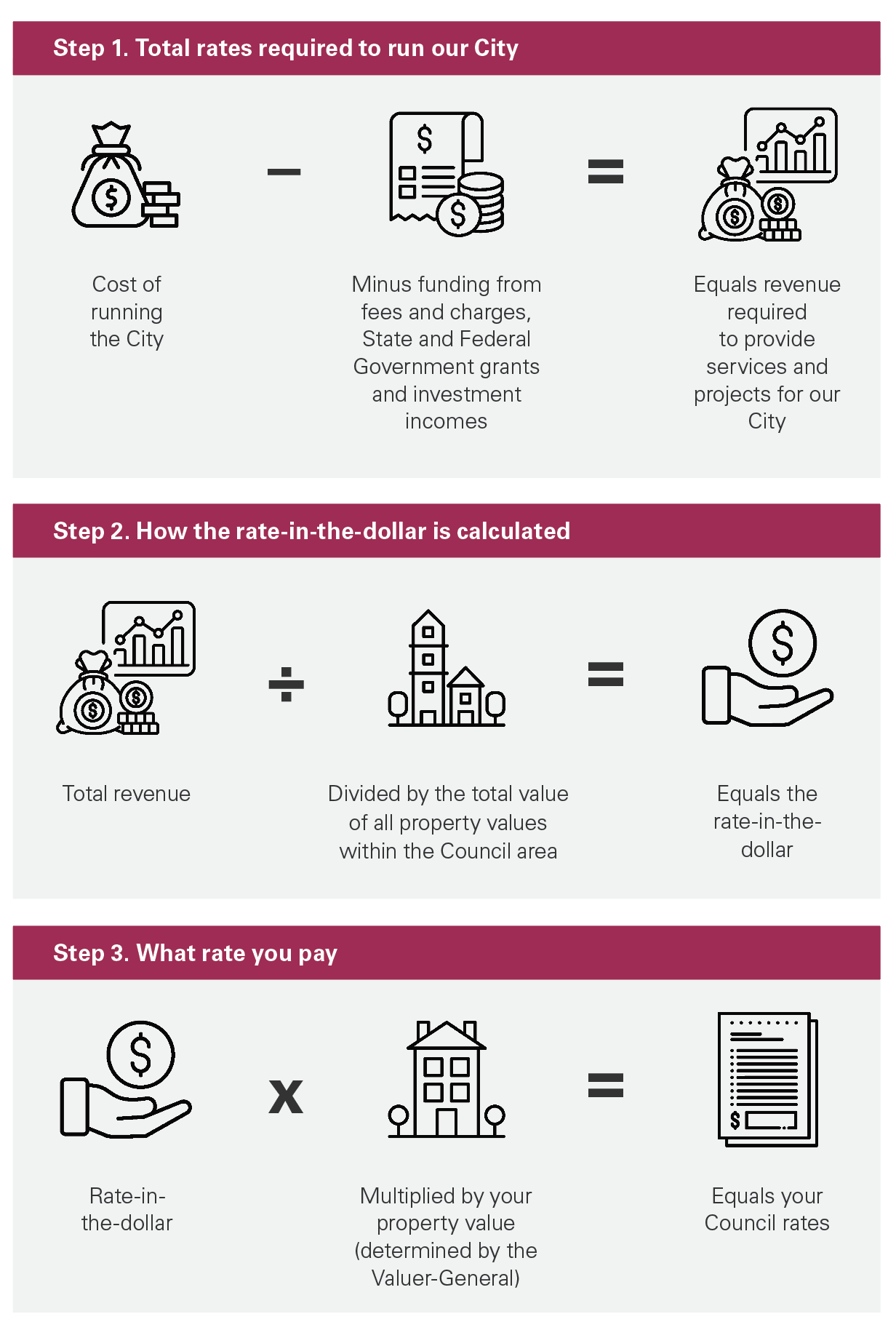
How is the Council’s debt being managed and reduced?
The Council is focused on managing peak debt levels through strategies for debt containment and reduction. Large projects have been reviewed,and some have been removed or rescoped to limit the impact on ratepayers. Borrowings are expected to reduce over the life of the Long-term Financial Plan, particularly in the second half of the 10-year period, as revenue growth allows for repayment. The goal is to reduce debt to approximately $18 million over time.
Read more about the assumptions guiding the Long-term Financial Plan in the Annual Business Plan, pages 8–12.
Why is the Council proposing operating deficits?
The proposed operating deficits in the draft Annual Business Plan are limited to the 2026–2027 and 2027–2028 financial years and represent a deliberate and managed outcome in response to evolving financial conditions. This is a planned, short-term position due to rising costs and the timing of major projects, not a long-term issue.
These short-term deficits were not previously forecast in the Long-term Financial Plan and have prompted a comprehensive reassessment of future capital investment. Importantly, the Council has reviewed its spending to minimise the impact on ratepayers. As part of this process, some large projects have been removed, rescoped or will be delivered more efficiently through existing renewal programs where appropriate. These decisions have significantly improved the Council’s financial position, with expected debt reducing to around $18 million over time and with Net Financial Liabilities improving to approximately 38%.
The current approach reflects prudent financial governance and a proactive approach to maintaining long-term sustainability, ensuring that investment is aligned with the Council’s financial capacity. It is designed to cushion sudden or significant rate increases, while still delivering essential services and maintaining community assets.
While there is a short-term impact on the budget, the Council’s long-term plan demonstrates a return to balanced budgets. This means services will continue to be delivered and infrastructure maintained, in a way that is financially responsible and sustainable for the community over time.
Will the Council provide me with support if I am experiencing financial hardship?
Yes. Ratepayers experiencing financial difficulties are encouraged to contact the Council’s Rates & Revenue Officer for confidential advice. The Council has a dedicated Financial Hardship Policy and offers options such as the postponement of rates for State Senior Card Holders.
What is the Essential Services Commission of South Australia (ESCOSA) report and what advice did ESCOSA provide the Council?
The Essential Services Commission of South Australia (ESCOSA) is an economic regulator for industries such as water, sewerage, electricity and gas. As of April 2022, ESCOSA was granted a new function under the Local Government Act 1999 to provide independent advice to councils on their financial and asset management plans.
The report is part of a state-wide Local Government Advice Scheme designed to provide transparency regarding a council's long-term financial health. All South Australian councils have now been reviewed through this process. Specifically, ESCOSA reviews:
- Amendments to the Long-term Financial Plan (LTFP) and Infrastructure and Asset Management Plan.
- Revenue sources and Annual Business Plan.
- The Council’s ability to manage debt and maintain infrastructure over time.
ESCOSA’s financial advice report for the City of Norwood Payneham & St Peters found the Council to have been and is currently, both financially responsible and sustainable.
The report recognises that to maintain this record of performance and sustainability, the Council must give careful consideration to debt reduction strategies and undertaking future projects, to ensure that any new initiatives are affordable and implemented in a financially responsible manner.
The following statement was provided to The Advertiser on Wednesday 25 February 2026:
The Council has considered ESCOSA’s assessment of the Council’s financial position over 10-year period, which has found the Council to have been and is currently both financially responsible and sustainable.
The Council notes ESCOSA’s comment regarding the recent changes to its financial position and understands what it needs to do to improve its financial outlook while balancing impending renewal commitments for its facilities and infrastructure.
The Council also recognises the current economic environment which has impacted on the cost pressures associated with upgrading and renewing ageing Council facilities.
The Council undertakes regular reviews of its Long-term Financial Plan (LTFP) and will do so again as part of the 2026–2027 Budget process, including looking at projects and proposed timelines to ensure any new initiatives are affordable and implemented in a financially responsible manner.
The Council has been considering debt reduction strategies since mid-2025, which includes looking at its rating policy, and will carefully consider all recommendations made by ESCOSA as part of its overall fiscal management strategy in the coming weeks.
The Council is extremely proud of the new Payneham Memorial Swimming Centre, which is a once in a half-century project, and our community is eagerly anticipating its opening scheduled for August.
A full copy of ESCOSA’s Advice for the City of Norwood Payneham & St Peters is available on the ESCOSA website
Why is the Council proposing to build a gym at the Payneham Memorial Swimming Centre?
Like with many other public swimming centres without additional/alternative revenue streams, the Council is committed to reducing the financial impact of operational costs of the Payneham Memorial Swimming Centre on ratepayers — which, depending on future demand may require an annual Council operating subsidy of approximately $1 million to operate.
To reduce reliance on this subsidy and enhance the offering at the Payneham Memorial Swimming Centre by providing a full aquatic and fitness service, the Council is proposing to construct a new gymnasium facility as part of the precinct.
Based on independent financial forecasts and industry feedback, the integration of a gymnasium facility is expected to generate a net financial benefit (operating surplus) to Payneham Memorial Swimming Centre operations over its expected life.
Importantly, this financial benefit just impact users of the Payneham Memorial Swimming Centre but provides a benefit to all rate payers by reducing the amount of rate revenue required to fund the Centre’s operations and provides an opportunity to more quickly pay down the Council’s debt.
How will the gymnasium compete when there are already many gymnasiums in the community?
The integration of aquatic and gymnasium facilities provides a unique health and fitness value proposition to customers that is not typically available through standalone private gymnasiums. In this respect, the inclusion of a gymnasium within an aquatic centre seeks to leverage the aquatic elements rather than compete directly with standalone private gymnasiums.
The combination of swimming pools, learn to swim, gymnasium, and health and fitness areas provides the community with a unique ‘one-stop’ opportunity for families and individuals to engage in health, well-being and/or recreation activities through a single membership offering.
The combination of aquatic and gymnasium facilities is proven to better respond to a broader level of community interests, provide improved community benefits and achieve a significant and enduring reduced cost of operating when compared to an aquatic facility that does not include a gymnasium.
I don’t intend to use the swimming centre and/or the proposed gymnasium — what benefit is this to me?
The inclusion of a gymnasium within an aquatic centre is proven to significantly reduce operating costs by providing an opportunity to generate higher levels of financial performance. Improving the overall financial performance of the Payneham Memorial Swimming Centre will benefit all rate payers by reducing the amount of rate revenue required to subsidise its operations and assist to more quickly reduce the Council’s debt.
How do we know that a gymnasium will be successful?
The Council has undertaken significant investigation to understand how the inclusion of a gymnasium will impact on the financial performance of the Payneham Memorial Swimming Centre. This has included independent analysis, comparison with other similar local government owned aquatic centres, input from leading national pool managers and an independent Prudential Report. Combined, this provides a rich level of evidence to inform the future impact on the Payneham Memorial Swimming Centre’s operating performance once the gymnasium is completed and achieves an expected level of full participation.
Will the Council need to borrow more money to construct the gymnasium?
The combined cost of constructing a gymnasium and associated car park and pedestrian bridge is estimated to be $5.9 million. The current financial modelling indicates that the gymnasium will achieve a payback period of 11 years on the Council’s investment in the Project. The Council is proposing to construct the gymnasium within the existing forecast borrowings contained within its current Long-term Financial Plan.
What services will the gymnasium offer?
In addition to the diversity of services to be offered at the Payneham Memorial Swimming Centre, the inclusion of a gymnasium will provide the community access to dry weight and various health and fitness services. The Centre will become a destination for community health, well-being and recreation.
When will the gymnasium be open to the community?
The Council is seeking to understand community support for the Council’s proposal to invest in construction of a gymnasium and associated car park at the Payneham Memorial Swimming Centre in order to reduce operating costs of the Payneham Memorial Swimming Centre. Should this proceed, it is currently estimated that the gymnasium would be open to the public in the middle of 2027.
Why wasn’t a gym built at the same time as the swimming centre?
Like with many other public swimming centres without additional/alternative revenue streams, the Council is committed to reducing the financial impact of operational costs of the Payneham Memorial Swimming Centre on ratepayers — which, depending on future demand may require an annual Council operating subsidy of approximately $1 million to operate.
To reduce reliance on this subsidy and enhance the offering at the Payneham Memorial Swimming Centre by providing a full aquatic and fitness service, the Council is proposing to construct a new gymnasium facility as part of the precinct.
Based on independent financial forecasts and industry feedback, the integration of a gymnasium facility is expected to generate a net financial benefit (operating surplus) to Payneham Memorial Swimming Centre operations over its expected life.
Who will run the gymnasium?
The gym will form part of the Payneham Memorial Swimming Centre and will be part of the integrated part of the service offering.
What is included in the $5.9m cost of the proposed gym?
The $5.9m budget includes construction of the proposed gym and associated costs for the car park, relocation of existing batting cages and sheds in Patterson Reserve and construction of a pedestrian bridge over Third Creek. It does not include the cost to renew other facilities at Patterson Reserve. Planning and preliminary design work for the renewal of the existing clubroom at Patterson Reserve will be undertaken during the 2026–2027 financial year in consultation with representatives from the East Torrens Baseball Club and the East Torrens Payneham Lacrosse Club.
Will there be further consultation on the gym proposal?
Community consultation will not be undertaken to inform the design of the gym. The financial implications of the project are being considered as part of the draft 2026–2027 Annual Business Plan and Budget consultation, which is currently being undertaken.
The redeveloped Payneham Memorial Swimming Centre supports a diversity of services including learn to swim, water safety education, lap swimming and recreation. It is envisaged that services delivered within the Centre will evolve over the life of the facility in response to community demand. Similarly, the proposed gym will support a variety of services including group exercise and strength training.
The design, which will continue to be refined with the preferred swimming centre manager, considers the necessary scale required to achieve a return on the investment, financially sustainable operations and ability to respond to community demand.
Has the Council secured funding for the gym proposal?
The Local Government Finance Authority (LGFA) has approved, in principle, additional borrowings to fund the construction of the gym and associated car park on Patterson Reserve and pedestrian bridge over Third Creek. Should the proposed gym project be endorsed by Council following consultation, the Council will work with the LGFA regarding the finalisation, timing and drawdown of borrowings to align with approved capital project delivery and cash flow requirements. Any borrowings will be managed in accordance with Council’s adopted financial strategy and borrowing limits.
Who will operate the gym and how will the operating risk be managed?
The proposed gym would be integrated into the Payneham Memorial Swimming Pool management and would be operated by the same specialist third party manager who will operate the Payneham Memorial Swimming Centre. Importantly, the gym will provide an additional service rather than operate as a standalone and separate gym business.
The Council has undertaken independent financial modelling to determine the viability of the proposed gym. The financial forecasts incorporate benchmarked performance of other similar aquatic centres that include a gym.
As part of the Payneham Memorial Swimming Centre management procurement process, tenderers were invited to:
- provide commentary on the viability of including a gym within the Payneham Memorial Swimming Centre;
- assess the gymnasium concept designs and provide feedback in relation to its commerciality and functionality; and
- provide a three-year budget.
In response, all tenderers:
- tenderers strongly supported the inclusion of a gym;
- made suggestions to improve the design to improve functionality and, in some cases, to reduce the capital cost; and
- provided a budget based upon an assessment of expected performance (including demand).
As a result, the Council’s independent modelling was updated to reflect a slight reduction in participation and increases to electricity and staffing costs.
The forecast participation (and associated financial modelling) reflects a participation level at 70% of the participation levels consistently achieved at The Arc (which typically operates at full capacity when compared to the Payneham Memorial Swimming Centre).
How will the Council manage the capital cost within the proposed budget?
The Council has progressed the design of the gym to approximately 30% completion. This level of design provides the necessary detail from which a reliable cost estimate can be developed.
The gym design presents as a lower-risk construction project when compared to the complexity of the Payneham Memorial Swimming Centre construction project.
Further, the Council has also utilised the existing Payneham Memorial Swimming Centre project team to retain knowledge of the site and the design and construction of the swimming centre, mitigating against risks associated with unforeseen construction and design challenges.
It is also envisaged, based on advice from the Council’s preferred manager of the Payneham Memorial Swimming Centre, that some minor modifications can be made to the design which offer value management opportunities to control budget overruns.
Since obtaining this cost escalation, and noting the impact of world events, the Council’s independent cost estimator (Rider Levett Bucknall) has revised their Tender Price Index (used to inform the cost of escalation). The impact of the revised Tender Price Index is outlined below:
a. An increase from 6.0% to 6.7% for the tender period from October 2025 to February 2027; and
b. An increase from 2.0% to 2.5% for the construction period from February to December 2027.
This represents a total variance of 1.2% which equates to a cost increase of approximately $46,000 (on the basis construction occurs in the period outlined).
In addition, the construction of the gym will be subject to an external tender process. Hence, the final decision to progress the project will be subject to receiving a fixed tender price from the construction market.
How is the payback period calculated and does it include the cost of borrowing and depreciation?
The Council has assessed the viability of the gym project using standard investment appraisal metrics. On this basis the project (inclusive of the construction of the gym and additional car park) has an estimated payback period of approximately 11.1 years.
In addition, the project’s rate of return is calculated at 11.53% which comfortably exceeds the Council’s cost of borrowing, indicating that the operating cashflows generated by the gymnasium are sufficient to service and outperform the cost of finance over time.
On this basis, the project demonstrates a strong positive Net Present Value (NPV) of $6,178,953 over an assumed 40-year asset life. The NPV analysis considers the cost of borrowing and reflects a value based on today’s prices.
As is consistent with financial principles, the payback period is calculated on a pre-financing basis, which is the conventional approach for assessing the underlying performance of a capital investment, independent of how it is funded. Similarly, the cost of deprecation is also excluded from this assessment. Whilst the Council is required to make provision for the cost of deprecation within its Budget, it is not viable to predict whether the asset would be renewed at its end of life for the purpose of being a gym. Such consideration would be subject to an additional cost benefit analysis at that time.
It is also important to note that whilst a 40-year life has been used to inform the calculation of depreciation currently, if approved, both the gym and car park would be subject to the Council’s normal valuation and depreciation methodologies (e.g. car parks typically have a useful life of approximately 100 years).
There are already numerous gyms in the area. How would an additional gym be competitive?
The forecast financial performance of the gym is informed by benchmarked performance of similar aquatic centres that include a gym. These centres also operate in locations that include numerous privately managed gyms. On this basis, the financial modelling reflects the financial result achieved when operating in proximity to other gyms.
Notwithstanding this, when incorporated into an aquatic centre, gyms do not directly compete with many gym offerings (i.e. 24/7 self-service gyms) and are not as susceptible to the same competitive environment.
This is because an aquatic centre, including when it incorporates a gym, is designed to include a range of different features/assets that enable it to offer a diverse range of services. In combination, this serves two purposes:
-
it offers customers a unique membership opportunity through which they can access a range of aquatic and dry fitness services; and
-
it provides the Centre with a diversified income base allowing it to be flexible in the way it responds to the various needs of a community.
These benefits position a gym that is incorporated into an aquatic centre in a different market and attracts a different customer base.
In addition, the combination of these different services/assets provides a significantly improved opportunity to have positive impact within the community, responding to all community demographics and families through services ranging from recreation to health and wellbeing.