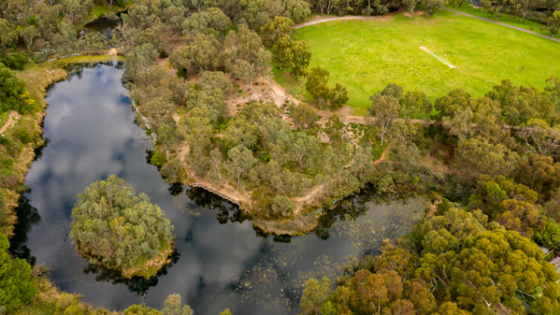
Just three kilometres from Adelaide’s city centre lies one of the eastern suburbs’ hidden gems—the St Peters Billabong. Surrounded by leafy trees and filled with local wildlife, it’s a peaceful spot where families, friends and nature lovers can relax and explore.
History of the Billabong
The Billabong’s story began long ago as part of the River Torrens. Over time, the river naturally changed course, leaving behind a curved section of water known as an oxbow. In the late 1970s, the former Town of St Peters worked to separate this oxbow from the river, officially creating the St Peters Billabong, which opened to the public in 1988. Today, the City of Norwood Payneham & St Peters owns and manages the Billabong.
Engineering studies and monitoring
Over the years, engineers have carried out several studies to understand if the Billabong’s slopes have been compromised. The first major study was undertaken in 2000, when the Torrens Catchment Water Management Board explored turning the site into an urban wetland to help treat creek water before it entered the river.
In 2019, community members raised concerns about public access and the safety of the slopes. In response, the Council commissioned new geotechnical investigations to determine of the land had changed since the original baseline study.
The results, confirmed by engineering experts in 2020, were reassuring — the slopes were stable, and there were no signs of major erosion or slippage.
The Council has continued to invest in monitoring the site, setting aside funds in the 2024–2025 Budget for further investigations. These included soil testing, engineering analysis, and an independent tree assessment. The findings once again showed that the Billabong’s embankments have remained largely stable for more than 25 years.
Recommendations and safety measures
Report findings indicate that while ongoing monitoring is important, no major construction or infrastructure work is required in the short or medium term. Instead, they recommend keeping development away from the top of the slopes and continuing regular checks to ensure the land and Billabong remain safe.
To protect both visitors and the environment, the studies also suggest creating a three-metre exclusion zone along the slope’s edge. This safety buffer helps prevent accidents and reduces wear on the banks caused by foot traffic and erosion.
A final report outlining these recommendations was presented to the Council in November 2025. For a summary of the recommendations, download: Council Minutes – 3 November 2025
With careful management and regular monitoring, the St Peters Billabong will continue to be a safe, beautiful space for everyone to enjoy for many years to come.